

Medical Billing and Coding Company Compliance: How Billing Errors Quietly Drain Healthcare Revenue
Medical billing and coding company compliance becomes painfully obvious only when revenue slips away without warning. You may see more denied claims, slower reimbursements, declining cash flow, and frustrated billing teams — but the real cause is often hidden: billing and coding errors that violate compliance standards, drain revenue cycle management healthcare performance, and sap growth.
Healthcare leaders can’t afford surprises. When billing errors become routine, they aren’t just operational problems — they become strategic threats to financial health.
In this article, we’ll explore why compliance matters, what the latest industry data tells us, and how smart billing practices can protect your bottom line.
The True Cost of Billing Errors Today
Medical billing mistakes are common — but not harmless.
Recent industry data shows that an estimated 10–15% of medical claims are rejected due to coding errors, and up to 80% of medical bills contain errors, creating massive delays and unnecessary costs for providers.
That translates into billions in lost revenue and administrative burden — and that’s before you count the negative impact on patient trust and compliance exposure.
Why Billing Compliance Is a Strategic Financial Priority
Billing compliance isn’t just about avoiding audits or penalties. It directly affects cash flow, operational efficiency, and patient satisfaction.
Accurate coding and documentation reduce claim denials, shorten days in accounts receivable, and lower administrative costs — all of which support healthier revenue cycle management.
Without it, providers could be leaving 5–10% or more of their potential revenue on the table, simply because claims are returned, rejected, or delayed due to preventable errors.
A Micro Case Example: When Small Errors Create Big Losses
A medium-sized outpatient clinic reviewed its billing performance and identified a 12% initial claim denial rate, primarily caused by incorrect modifiers and incomplete patient demographics. Over a three-month period, nearly 20% of denied claims were never reworked, resulting in an estimated $520,000–$580,000 in annual lost revenue — all linked to basic compliance and coding gaps.
In-House vs Outsourced vs Hybrid Billing: A Quick Comparison
| Billing Model | Strengths | Limitations |
| In-House Billing | Full control, immediate access to records | High training costs, harder compliance scaling |
| Outsourced Billing | Specialized expertise, reduced denials | Less oversight unless vendor is transparent |
| Hybrid Model | Best of both — internal control + expert support | Requires strong coordination |
Choosing the right model depends on your practice size, claims complexity, and growth goals — but outsourced or hybrid models often improve compliance and reduce denials faster than in-house teams working alone.
The Latest Industry Trends You Need to Know
Healthcare billing is evolving rapidly, and compliance demands are rising:
- Initial claim denial rates are rising, with averages around 11.8% in 2024–2025, driven largely by coding and documentation issues.
- Denied claim amounts for hospitals increased by double digits, with payer audits rising year over year.
These trends confirm that billing accuracy and compliance are not optional — they are essential to maintaining financial performance.
7-Step Billing Compliance Checklist (Featured Snippet Ready)
- Verify patient demographics and insurance eligibility before service.
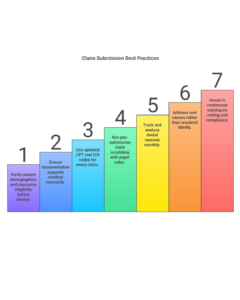
- Ensure documentation supports medical necessity.
- Use updated CPT and ICD codes for every claim.
- Run pre-submission claim scrubbing with payer rules.
- Track and analyze denial reasons monthly.
- Address root causes rather than resubmit blindly.
- Invest in continuous training on coding and compliance.
These steps reduce risk, shorten revenue cycle timelines, and help prevent costly denials before they happen.
What a Medical Billing and Coding Company Actually Delivers
A top-tier medical billing and coding company does more than file claims — it ensures compliance is built into every step of the revenue cycle.
Experienced teams apply payer-specific rules, conduct real-time edits, and monitor evolving regulations so your claims are accurate, compliant, and optimized for full reimbursement.
Compliance is not a one-time check — it’s a discipline.
How Marencor RCM Services Strengthens Your Revenue
At Marencor RCM Services, we specialize in compliant medical billing and coding services that help healthcare providers reduce denials, accelerate reimbursements, and protect revenue.
Our approach combines:
- deep domain expertise in medical billing and coding compliance
- tailored workflows based on your payers and specialties
- real-time claim validation before submission
- ongoing denial analysis and corrective feedback loops
The goal isn’t just fewer denials — it’s predictable cash flow, fewer audits, and better financial clarity so you can invest in care rather than chase invoices.
If billing feels busy but revenue feels unpredictable, that gap is usually a compliance issue — and that’s where Marencor adds measurable value.
Final Takeaway: Compliance Is a Growth Engine
Billing compliance is more than a requirement — it is a strategic financial advantage in today’s healthcare landscape.
Reducing errors, optimizing coding, and partnering with experienced RCM professionals means:
- fewer denials
- faster payments
- lower administrative costs
- stronger financial resilience
This is why healthcare providers that prioritize compliant workflows and expert medical billing partnerships stay ahead in both revenue and patient trust.